
How to Select the Perfect Marble Slab: An Expert’s Guide to Veining, Origin, and Grading
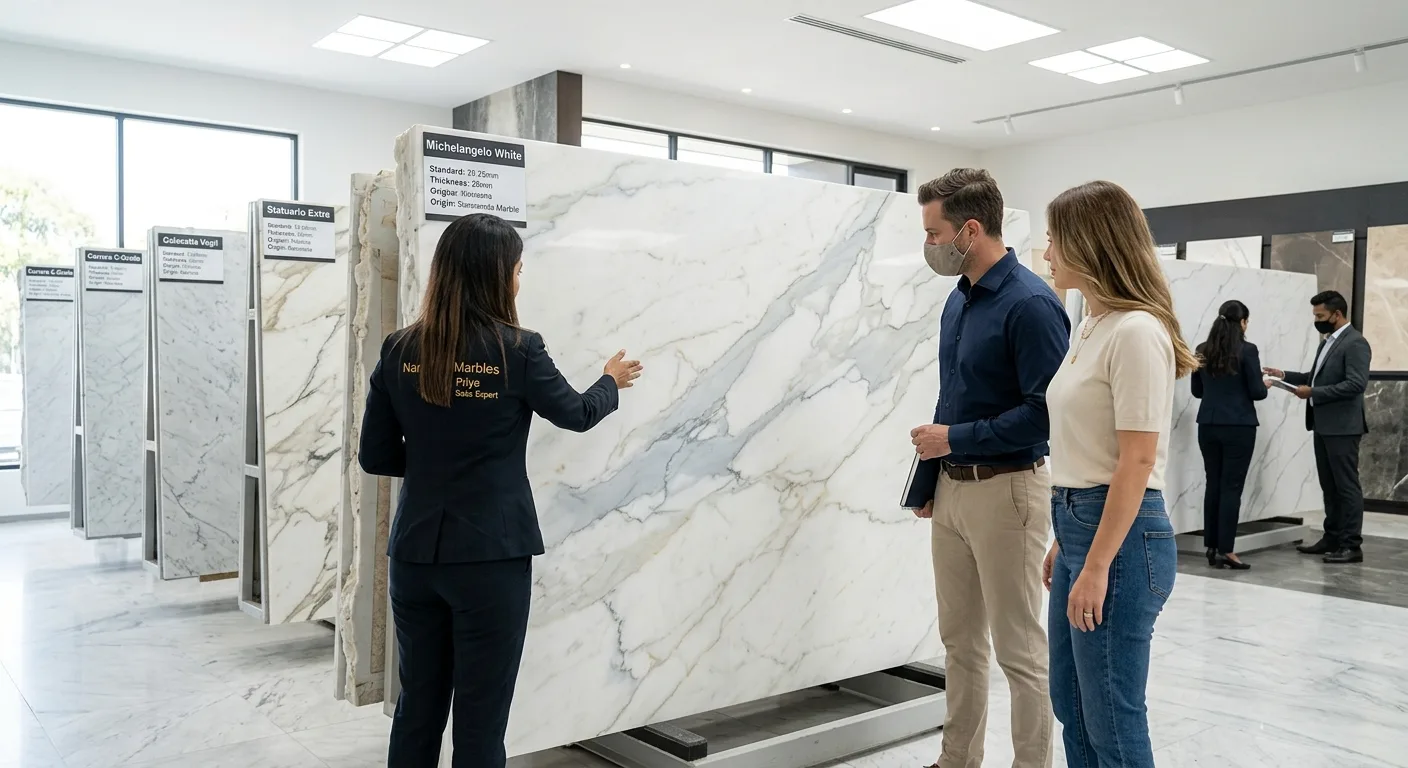
Selecting natural marble requires evaluating physical stone geology rather than relying solely on color aesthetics. Slabs vary across quarries in crystal grain structure, mineral composition, water absorption, and structural soundness. Making an informed purchase requires evaluating physical slabs under proper conditions rather than relying on small showroom samples.
- Understanding Provenance & Quarry Origins:
- Italian Classics: White marbles like Statuario, Calacatta, and Carrara come from the Apuan Alps region in Tuscany. Statuario is defined by a bright white calcite base with bold, dramatic grey veining. Calacatta features warmer, golden-grey tones, while Carrara offers a softer, blue-grey background with subtle linear feathering.
- Global Varieties: Fine varieties sourced outside Italy offer high structural performance. Greek Volakas provides soft cloudy grey veins on a creamy white background, while Spanish Crema Marfil delivers consistent beige tones for large-scale flooring.
- Evaluating Physical Slab Quality & Integrity:
- Thickness Standard: Verify that structural slabs maintain a consistent thickness of 18mm to 20mm (0.75 in to 0.80 in) across all four edges. Thin or unevenly cut slabs flex under stress and crack during setting.
- Fissures vs. Structural Cracks: Natural hair-line fissures are organic, mineral-filled lines that form part of the stone’s beauty. Open structural cracks or heavy epoxy mesh backing indicate a brittle slab that may fail during fabrication.
- Light Reflection & Sound Test: Inspect full slabs upright under natural daylight or high-CRI lighting. High-grade calcite marble yields a clear, mirror-like polish and produces a ringing tone when lightly tapped, signaling dense internal structure without hollow voids.
- Matching Stone Traits to Applications:
- Flooring: Choose fine-grained, low-porosity slabs with consistent color distribution to maintain visual continuity across wide expanses.
- Countertops & Vanities: Prioritize high-calcite varieties with lower absorption rates, ensuring the stone is sealed immediately upon installation.
Frequently Asked Questions
Check for a uniform thickness of 18mm to 20mm across all edges to prevent cracking during installation. Inspect full slabs upright under natural light to distinguish natural surface fissures from deep structural cracks, and ensure the back has no heavy epoxy mesh masking brittle stone.
All three originate from Italy’s Apuan Alps, but vary in rarity and veining. Carrara features a soft grey background with subtle feathering; Statuario has a bright white base with bold, dramatic grey veins; and Calacatta displays warm white tones with rich golden-grey veining.
Natural veining is formed by mineral deposits and is a hallmark of genuine marble quality. However, wide open cracks or heavy surface fill indicate structural weakness. Quality slabs feature tight calcite crystal structures with sealed, organic veining.